Fewer launch delays
Teams can enrich products from a shared source instead of chasing missing specs and media across departments.

Utomo gives manufacturers and distributors one governed place to structure product information, connect assets, coordinate launches, and prepare output for every team that depends on the catalog.
When information is scattered, every launch, publication, translation, and partner request creates another reconciliation task. Utomo keeps the source and the work around it in one system.
Teams can enrich products from a shared source instead of chasing missing specs and media across departments.
Consistent product data reduces duplicate work and avoids mismatched content between web, catalog, and marketplace output.
Accurate descriptions, documents, images, and specifications reduce confusion before and after purchase.
Each customer account owns its tenant, so one company never sees another company data or activity.
Select a role to see the current friction, the Utomo workflow, and the practical result.
Attributes, variants, identifiers, and relationships are maintained differently across spreadsheets and systems.
Typed attributes, attribute sets, categories, variants, associations, grids, and lifecycle states create one governed structure.
Teams update the source once and give every downstream workflow the same product context.
Utomo follows a simple product-content lifecycle that every team can understand.
Define products, attributes, categories, variants, associations, and lifecycle states.
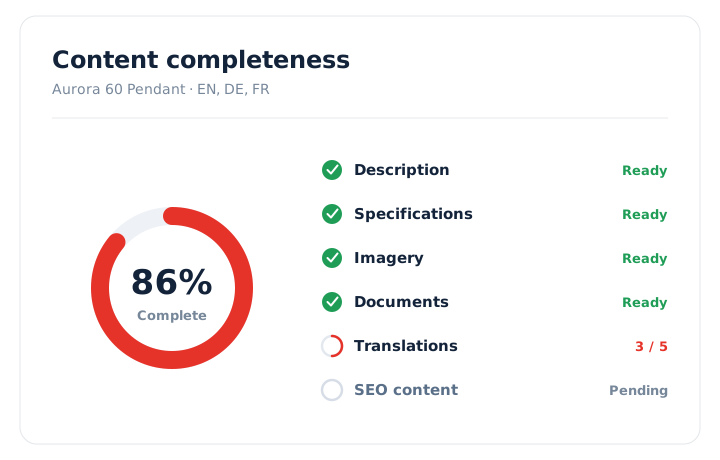
Add specifications, descriptions, translations, imagery, manuals, and supporting documents.
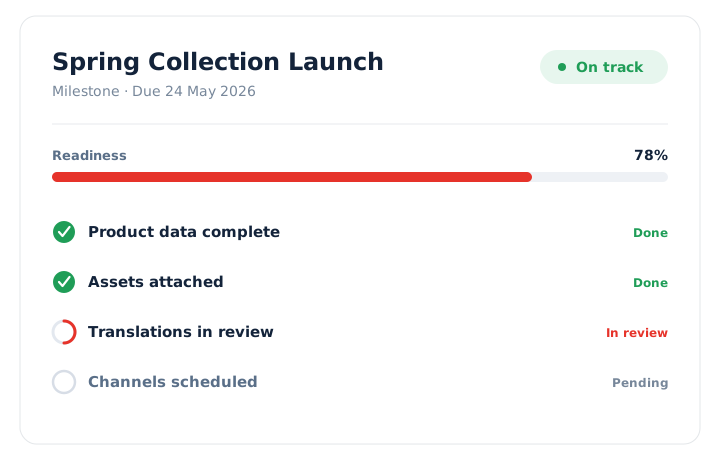
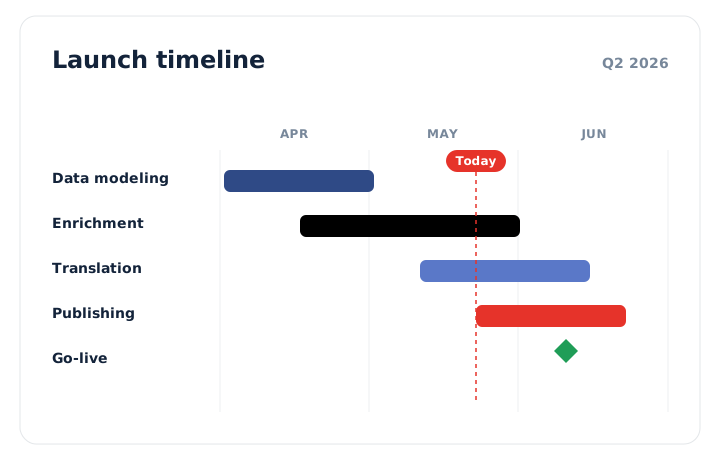
Review completeness, status, milestones, permissions, and processing activity.
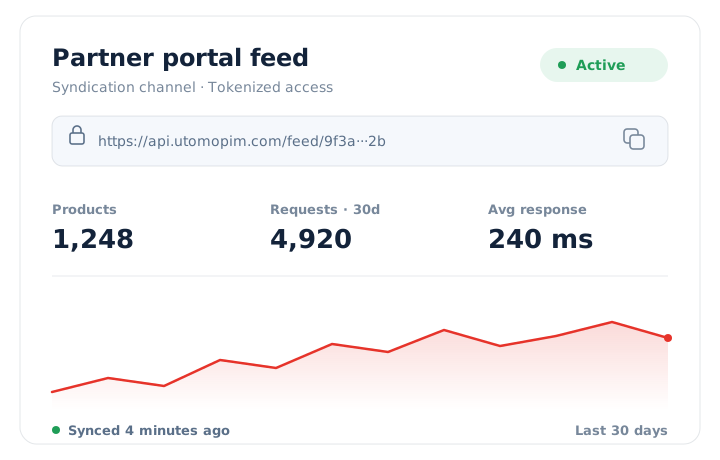
Run repeatable exports and publications or provide controlled product-feed access.
Spreadsheets can hold values and specialist tools can solve isolated tasks. Utomo connects the product source to the operational output.
| Work area | Spreadsheets and folders | Disconnected point tools | Utomo |
|---|---|---|---|
| Product source | Multiple versions and manual reconciliation | Structured data split across applications | One governed product model |
| Assets and content | Found by filename and folder knowledge | Stored separately from product context | Connected to products, families, and campaigns |
| Launch readiness | Tracked through manual status columns | Dates and product state remain separate | Completeness, status, milestones, and queues |
| Publishing | Copy, format, export, and repeat | Handoffs between source and output tools | Reusable templates, jobs, and controlled feeds |
| Access control | Folder-level sharing | Different permissions in every application | None, read, or write permission by module |
Utomo is designed so product work remains separated by customer and access is defined around the modules each team uses.
Utomo is engineered, secured, and operated with the same discipline we ask of your product data. Here is how we hold the platform — and ourselves — to it.
Isolated customer instances, tokenized feed access, encrypted connections, and least-privilege roles keep product data protected at every layer.
A modern, tested codebase with reviewed releases, performance budgets, and repeatable processing keeps the platform fast and dependable.
Documented workflows, clear ownership, change tracking, and structured governance make the way we work as controlled as the data we hold.
Onboarding, consultancy, and responsive expert support back the software, so teams adopt Utomo correctly and keep improving over time.
Start with a representative product group and test the complete route from structure to output.
Create the attributes, variants, categories, and relationships your catalog requires.
Add descriptions, imagery, documents, and translations to the product records.
Run a publication or export and configure a controlled feed where relevant.
Validate the model, permissions, workflow, and rollout scope before committing.
Utomo is the governed home for product information and content. An ERP remains responsible for operational data such as orders, stock, purchasing, and finance.
Yes. Images, manuals, documents, and other media can be categorized and attached to products, families, and campaigns.
No. A representative product group is enough to validate attributes, content, permissions, publishing, and the rollout approach during the trial.
Utomo provides reusable exports and controlled, tokenized product feeds. It does not claim a prebuilt marketplace connector network.
Use the 30 day trial to test your product model, asset structure, publishing needs, and team workflow before committing.